
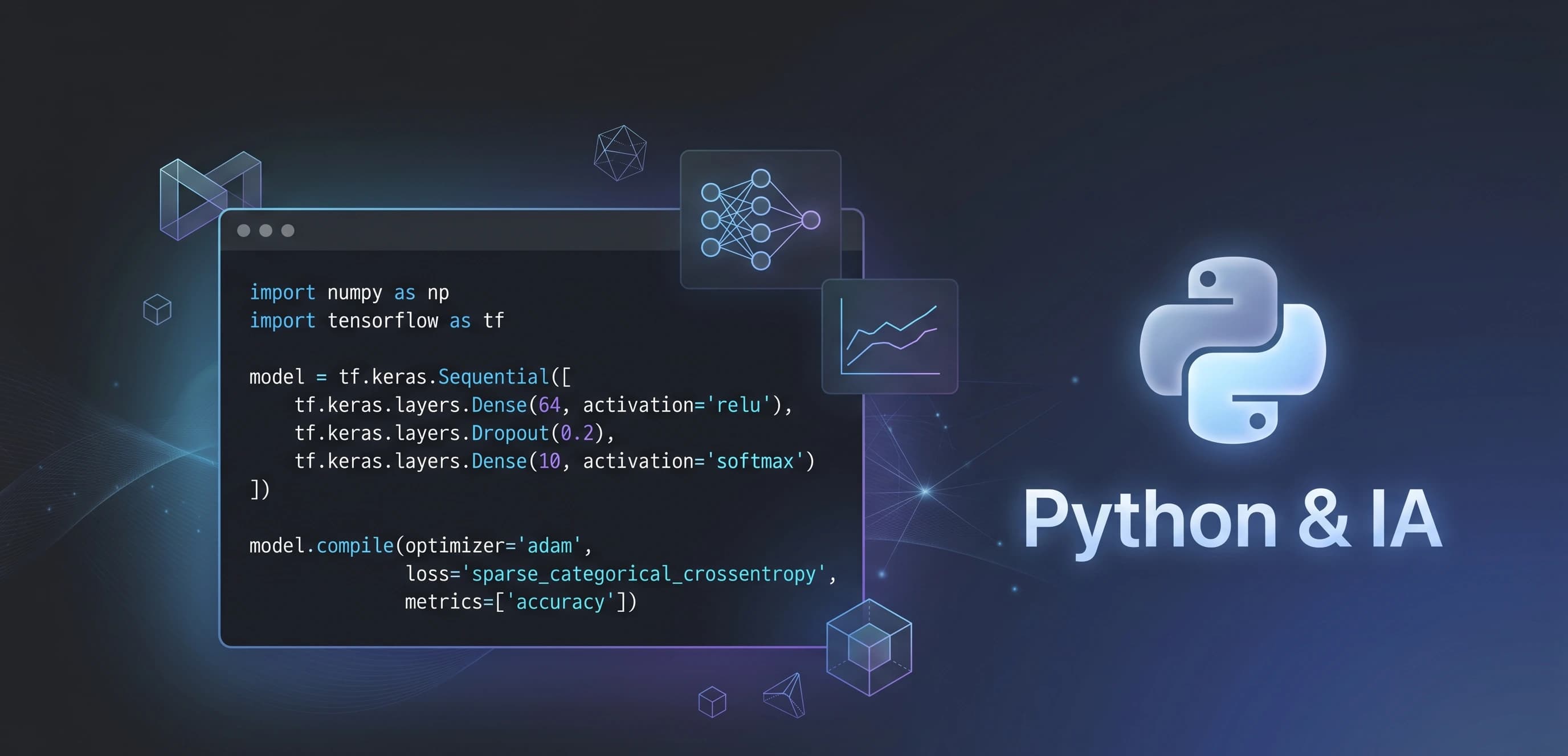
Python is the most popular language in the world according to the TIOBE index from early 2026, with over 21% share, and the main reason behind that number is artificial intelligence. In the Stack Overflow 2025 survey, Python usage among developers jumped from 51% to 58%, the largest annual increase of any language in recent years. It's not a coincidence: the most important AI frameworks, TensorFlow, PyTorch, and Scikit-learn, all run on Python.
If you're a junior developer who wants to get into AI, the question isn't whether to learn Python. The question is where to start without drowning in libraries you won't need yet.
Why Python and not another language
There are concrete reasons. The most widely used machine learning frameworks in production are Python-native. The community is enormous, which means you'll find documentation, answers, and tutorials for almost any problem you encounter. The syntax is clean and lets you focus on the problem before the language.
According to Stack Overflow 2025, 84% of developers use or plan to use AI tools in their work. Python is the language that connects those tools. There's no close second for that specific role.
The most common mistake when starting out
Most articles about Python for AI throw 15 libraries at you in the first screen. NumPy, Pandas, Matplotlib, Scikit-learn, TensorFlow, PyTorch, Keras, Hugging Face, LangChain, and more. The result is that you don't know where to begin and end up learning the names of things without understanding how they connect.
The reality of a machine learning project is that it has an order. First you manipulate data, then you visualize it to understand what you have, then you prepare it for a model, and finally you train and evaluate. Each library exists for a specific part of that flow, and if you learn in that order, everything makes sense much faster.
The flow and what to use at each stage
NumPy is the foundation of almost the entire ecosystem. It's a library for numerical operations with multidimensional arrays, and the reason Python can do C-speed calculations without you noticing. You don't need to master it deeply at first, but understanding how a NumPy array works will save you a lot of confusion later.
Pandas is the tool for working with real datasets — the ones that come in CSV, Excel, or databases. It lets you load, clean, filter, and transform data with an API that feels natural after a couple of days. In the real world, between 70% and 80% of the time on an ML project goes to this stage: dirty data, mistyped columns, missing values.
Matplotlib is the base engine for graphics in Python. It's not the prettiest, but it's the most compatible with the rest of the ecosystem. Seaborn is built on top of Matplotlib and gives you statistical charts with less code. For projects where the output needs to appear in a dashboard or a web app, Plotly is the most widely used option today.
Scikit-learn is the right entry point for any junior who wants to build their first predictive model. It has a consistent API that works the same way for linear regression, decision trees, clustering, or evaluation metrics. It's open source, BSD-licensed, and has one of the clearest documentation sets in the ecosystem. Don't learn TensorFlow or PyTorch before you understand Scikit-learn well. That's one of the things that slows junior developers down the most.
Deep learning: when and what to choose
Once you understand the data flow and have trained classical models with Scikit-learn, that's when it makes sense to move into deep learning. The two main options are PyTorch and TensorFlow.
PyTorch in 2026 dominates in research and is gaining significant ground in production. Its execution model is more intuitive for anyone coming from Python because it lets you inspect what's happening at each step. TensorFlow has advantages in large-scale deployment, with tools like TensorFlow Serving and TFLite for mobile. Keras is integrated as TensorFlow's high-level API and reduces a lot of the boilerplate.
For a junior starting today, PyTorch is the most recommended path because it has more modern learning resources and is the most widely used in the open source ecosystem.
Language models and NLP
Hugging Face Transformers is the standard library for working with pretrained language models. Models like BERT, GPT, and their variants are available with just a few lines of code. For projects that need to process text at volume or integrate an LLM, it's the right entry point.
A realistic timeline
If you can dedicate one to two hours per day, here's a progression you can follow:
| Period | Focus |
|---|---|
| Weeks 1 and 2 | Python basics: variables, functions, lists, dictionaries, basic classes |
| Weeks 3 and 4 | NumPy and Pandas with real datasets. Kaggle has free datasets to practice with from day one |
| Week 5 | Visualization with Matplotlib and Seaborn. Being able to chart distributions and correlations is enough to move forward |
| Weeks 6 to 8 | Scikit-learn: linear regression, decision trees, evaluation with train-test split, accuracy, RMSE, and F1 |
| Weeks 9 to 12 | Introduction to PyTorch: tensors, autograd, your first neural network |
| Week 13 onward | Your own projects: an image classifier, a predictive model, a basic chatbot |
Your portfolio matters more than your courses. A simple project that works and lives on GitHub says more about you than five certificates without any code.
What you don't need to learn yet
LangChain, LlamaIndex, MLflow, Ray, Spark, Airflow. These are real tools widely used in production, but they're for when you already know how to build and evaluate models. Learning them first is like learning pit stop techniques in Formula 1 before learning how to drive.
"The developers who progress fastest aren't the ones who read the most — they're the ones who build things from the first month, even if they're simple."
- Carlos José Castro Galante
To wrap up
The path isn't short, but it's not impossible either. The key is to go in order and not jump to deep learning before you understand how a data pipeline works.
Kaggle has short courses on Python, Pandas, and machine learning that are completely free. Fast.ai has one of the best free resources for going from Scikit-learn to PyTorch. And Microsoft Learn has Python and AI learning paths you can follow at your own pace.