
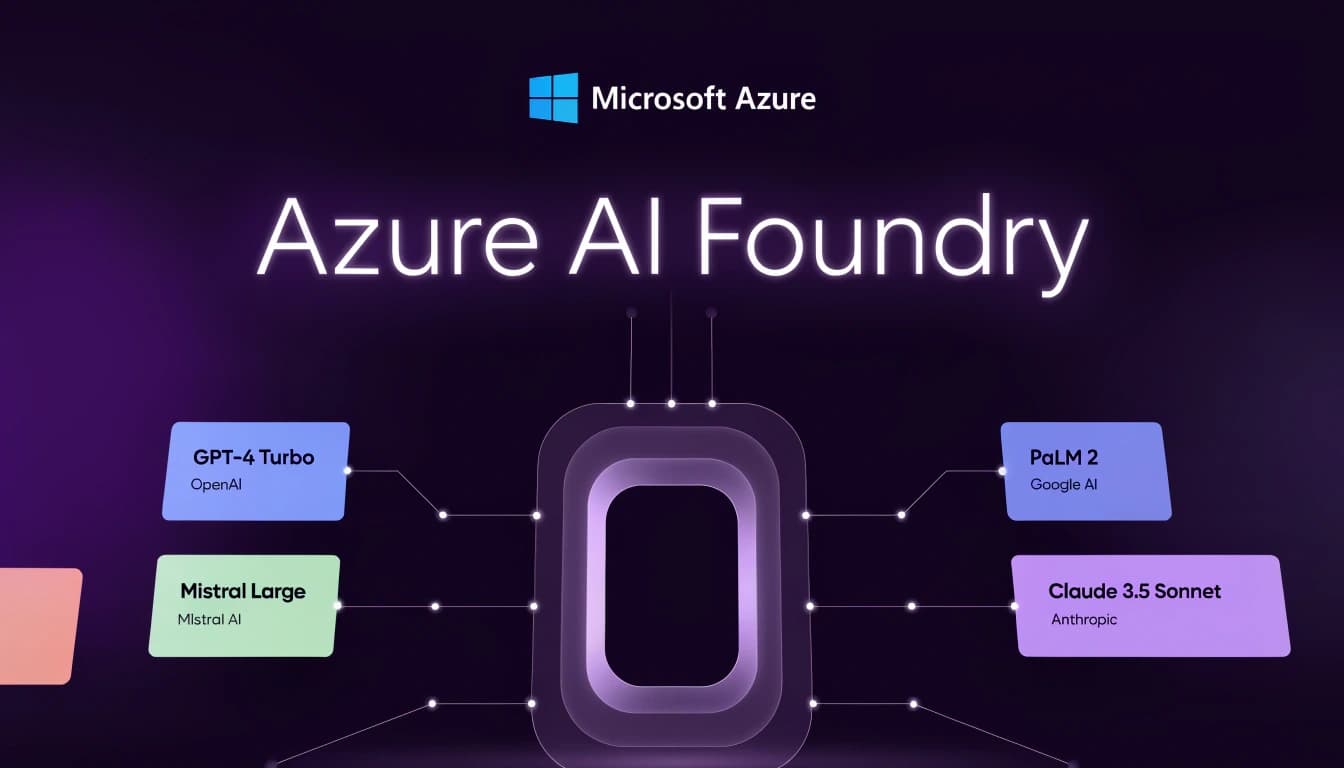
If you've ever worked with Azure OpenAI Service or Azure AI Studio and you open Microsoft's documentation today expecting to find the same thing, you've probably gotten lost. The names changed, the resources were consolidated, and what used to be three separate services now lives under one name: Azure AI Foundry.
This post explains what Azure AI Foundry is in 2026, how it differs from what came before, and what you need to understand whether you're starting fresh or coming from using Azure OpenAI directly.
What Azure AI Foundry is
Azure AI Foundry is Microsoft's unified AI development platform. It replaced Azure AI Studio at the end of 2024 and expanded its scope beyond OpenAI models to include Phi, Mistral, Llama, Cohere, and many more.
In concrete terms, it's the place where Microsoft consolidated everything that was previously scattered: the model catalog, evaluation and prompt engineering tools, endpoint deployment, fine-tuning, observability, and agent building. All under a single portal at ai.azure.com and a single resource layer in Azure.
The catalog has over 1,900 models ranging from Foundation Models and Reasoning Models to Small Language Models, multimodal models, domain-specific models, and industrial models.
The difference from Azure OpenAI Service
This is the most common source of confusion, and it's worth clarifying directly.
Azure OpenAI Service is a managed service focused exclusively on providing access to OpenAI models like GPT-5, GPT-4o, GPT-4.1, embeddings, and multimodal models. It runs on Azure infrastructure and adds enterprise features like security with Microsoft Entra ID, content filters, scalability, and integration with Azure tools.
Azure AI Foundry is a broader platform oriented toward building, customizing, deploying, and managing AI applications and agents. It includes Azure OpenAI as one of its components under Foundry Models.
The simplest way to understand it: Azure OpenAI Service still exists and you can use it directly for API calls without needing the entire Foundry ecosystem. But if you're building something more complex — with multiple models, evaluation, agents, or fine-tuning — Azure AI Foundry is where all of that lives today.
Available models
The catalog includes models from OpenAI, Anthropic Claude, Fireworks AI, DeepSeek, xAI, Hugging Face, Meta, Mistral AI, Cohere, Stability AI, NVIDIA, and more. Models fall into two main categories.
Models sold directly by Azure: hosted and sold by Microsoft under their own product terms. Microsoft evaluated them and they're deeply integrated into the Azure ecosystem. They come with a guaranteed SLA and first-party support.
Partner and community models: supported by their respective providers with varying levels of SLA and support. They offer rapid access to specialized innovations from research labs and emerging providers.
The distinction matters in production: for enterprise environments where SLA and support are critical, Azure's direct models are the safer choice.
What disappeared and what's about to disappear
The resource structure collapsed. Previously, a typical AI deployment in Azure required three separate resources: an Azure OpenAI account, an Azure AI Services account, and an AI Hub. That was consolidated into a single Foundry resource that hosts multiple projects.
The Assistants API has a definitive retirement date of August 26, 2026, replaced by the Foundry Agent Service Responses API. If you have agents built on the Assistants API, the time to migrate is now.
What you can do from the portal
The Azure AI Foundry portal at ai.azure.com gives you access to everything without having to touch code first. You can explore the model catalog, compare models side by side using your own data and prompts, fine-tune models like GPT-4o, GPT-4o-mini, Llama, and Phi, deploy endpoints with a couple of clicks, and monitor model behavior in production.
The Serverless API, also called Model as a Service or MaaS, is the most accessible type of deployment to start with. It lets you access models hosted in Azure without provisioning GPUs or managing backend infrastructure. You pay for what you use.
From code
The official SDK for working with Azure AI Foundry from code is azure-ai-projects, available for Python, JavaScript, TypeScript, and .NET. The current version is 2.2.0 and includes support for external agent definitions, skills, toolboxes, model weight registration, routines, and optimization jobs.
from azure.ai.projects import AIProjectClient
from azure.identity import DefaultAzureCredential

client = AIProjectClient(
    endpoint="https://your-endpoint.services.ai.azure.com/api/projects/your-project",
    credential=DefaultAzureCredential()
)

response = client.inference.get_chat_completions(
    model="gpt-4o",
    messages=[{"role": "user", "content": "Hello, what is Azure AI Foundry?"}]
)
print(response.choices[0].message.content)
Basic model call from azure-ai-projects in Python.
And if I'm studying for AI-103, where does this fit?
If you're preparing for the AI-103 certification, Azure AI Foundry is the central platform of the exam. Microsoft Foundry replaced Azure AI Studio as the reference environment for building production-ready AI applications. Understanding how the portal is organized, how projects are created, and how models are deployed is knowledge that's directly tested.
The same applies if you're coming from AI-102: the architecture you previously studied with Azure Cognitive Services and Azure Applied AI Services is now reorganized within Foundry. The services still exist, but the access point and the way they're managed has changed.
"The naming confusion between Azure OpenAI, Azure AI Studio, and Azure AI Foundry slowed a lot of people down over the past few months. The reality is that the platform evolved into something more complete, and the entry point today is just one: Foundry."
- Carlos José Castro Galante
To start wrapping up
Azure AI Foundry has a free tier in the portal that lets you explore the catalog and test models without needing a paid subscription. For production deployments, the Serverless API model charges per token consumed depending on the model you choose.